Showing posts with label reviews. Show all posts

Tuesday, July 19, 2011

Gatling Gears

Rose accidentally bought Gatling Gears on the PS3, so I played it. It's a twin-stick shooter in the Robotron vein, set in a steampunk world.


Copious, slow-moving patterns of bullets (“bullet hell” I think I've heard it called) are a game mechanic that came out of games like Raiden. This mechanic seems to be getting mixed in to more things these days; Outland combined it with side-scrolling platforming (and Ikaruga's phase-changing) recently, for instance.

Unfortunately Gatling Gears looks unfinished in some respects. The gameplay apart from the bosses is very monotonous. I actually found myself looking forward to the bosses which is a reversal from the usual.

The story is nearly nonexistent. There are story cards inserted between the half-dozen chapters, and printed dialog exchanges at points during the gameplay, which you're apt to miss if you are busy. What story there is seems trite and predictable. You're best off reading Scott Westerfeld's Leviathan series (my review) and imagining that story overlaid on this game. It works pretty well.

The graphics are lovely, though. I am going to go back through the game and try to figure out how the environments were assembled.

Wednesday, January 5, 2011

Treasures of a Slaver's Kingdom is Now Free

Good news, everybody! S. John Ross' magnificent text adventure Treasures of a Slaver's Kingdom is now free.
Enjoy!

Monday, November 1, 2010

Reviews: Sherman Alexie and Marjane Satrapi

Here in the Pacific Northwest it hasn't been long since the land changed hands. A lot of sad things happened and are still happening. I used to walk over to the site of the Whitman Mission on Saturday afternoons. Some people brought religion and farming and smallpox there and got killed in 1847 and it started a series of wars. I haven't ventured into any of the area's many reservations other than passing through on the highways, but when I fly over the Yakama reservation and see the trailer homes on the barren hills surrounded by their trash collections I imagine the sadness radiating upward. (Maybe my imagination's way off, though!)

The Absolutely True Diary of a Part-Time Indian is Sherman Alexie's semi-autobiographical novel about leaving the Spokane Indian Reservation, with illustrations by Ellen Forney. Arnold Spirit (“Junior”) is fourteen when he discovers his mother's name in his geometry textbook; the school hasn't acquired new books in the last 30 years. His teacher convinces him he has to leave the reservation to fulfill his potential. Junior transfers to Reardan High in a nearby white farm town, where he and the school's mascot are the only Indians. His tribe (apart from his family) take it as betrayal. When he makes the Reardan basketball team he finds himself up against his former best friend.

“Diary” is poetic, funny, sad, and raunchy. It ought to ring true with anyone who has had to leave home and family to get where they are.

Speaking of cultural displacement, the Pacific Northwest area now has a large Iranian immigrant population, including a bunch of Baha'i.

Persepolis: The Story of a Childhood


Marjane Satrapi was in grade school in Tehran when the Islamic revolution happened. Suddenly she was forced to wear a veil and attend segregated school. Then things got worse. Her parents eventually shipped her off to France when they realized that she wouldn't be able to have the life they wanted for her.

Once she found her feet in France, Satrapi produced this beautiful black-and-white graphic novel autobiography. She's done several more volumes and an animated film. It's been a while since I read this but I recommend it highly as well if you want to know more about what's happened in Iran.

Monday, September 27, 2010

Minecraft, Layton Reviews

Took a week of vacation at home; sigh, yes, a “staycation.” Amongst other things I managed to play a few computer games:

Minecraft

I've spent a ton of time playing this game. Rock, Paper, Shotgun ran a play diary which convinced me it was worth shelling out for in its alpha state. I have not been disappointed.

Here's a fan-made trailer for the game:


Minecraft (in survival mode) drops you into an infinite, randomly-generated world. Your immediate goal is to survive the nights, when various monsters come out. Once you have your basic safety assured, though, you are free to explore, dig mines for rare materials, and construct grandiose architecture. The game's in alpha and has been built by one man so far. Due to its increasing popularity he is hiring help though.

Professor Layton and the Unwound Future

Just finished this third game in the Layton series of puzzle games. It's as charming as ever; the production levels are steadily rising as the series progresses, with more voice acting and more beautiful animated movies than I remember in the previous installments.

A Layton game strings together a big collection of brain teasers with a barely-related story in which Professor Layton and his boy sidekick Luke solve mysteries. In this case they have received a message from someone claiming to be Luke from ten years in the future, requesting aid. Layton's lost love also comes into the tale; she was a scientist who died in a mysterious laboratory explosion ten years prior.

If you get stuck you can spend hint coins for increasingly specific tips. If you've played the previous Laytons, I think they've dialed back the puzzle difficulty quite a bit here. I don't mind too much; I was fairly frustrated in a few places in the first game.

A couple other games I've been playing but haven't finished:

Zak and Wiki: Quest for Barbaro's Treasure

A point-and-click adventure game for the Wii platform. Kind of fun. I'm playing through it a little bit at a time with my four-year-old.

Dragon Quest IX: Sentinels of the Starry Skies

I am generally pretty burnt out on Japanese role-playing games. This one seems like it's quite charming, despite having a very, very traditional battle system. I'm trying to save my JRPG stamina for the Ghibli-co-produced ones coming out next year so I don't know if I will finish this one.

Friday, August 20, 2010

A Couple of YA Novels

I like young adult novels because they tend to be short. There's been a discussion recently amongst independent game developers about how long people expect games to be relative to their price. One of the mistaken points I've seen made a few times is that it's only games consumers that judge their media by its length. I'm pretty sure there's a pressure in the adult fantasy/sci-fi genre for novels to be bloated, poorly edited messes. A book needs a map in the front, “Part One of the Demon Kingdoms Saga” on the back cover, and seven or eight hundred pages of typo-laden prose in between. Fortunately you can go to the young adult field and find tightly-plotted, well-characterized books that won't waste your time. Here are two:

Ship Breaker by Paolo Bacigalupi. An oil-less near future on the flooded Mississippi coast. Nailer, a child laborer (the eponymous ship breaker) falls in with a shipwrecked princess on the run. The characters are vividly drawn, the drama is intense, and the plot comes together well. Nailer's abusive father is a particularly strong villain. Not a cheery book but the atmosphere is thick and novel. Impossible to put down once started. Bacigalupi has also written a (much longer) adult novel in similar vein, The Windup Girl.

Leviathan by Scott Westerfeld. Westerfeld, already a prolific and accomplished YA writer, tries his hand at this newfangled steampunk thing. It works out pretty well, and has a sequel coming out in a couple of months. It's an alternate history version of World War I where the British have got genetic engineering down pat (with which they create the requisite steampunk dirigibles) and the Germans have gigantic walking fighting machines (because really, what universe should not have these?) Deryn, a young girl, hides her sex to enlist on a dirigible, shipwrecks and falls in with a prince on the run. Similarly un-put-downable.

Monday, June 7, 2010

Games I'm Playing

The runup to E3 at work has been busy. I've been getting back to putting in an hour a night on my lunar-lander-on-a-disc, though. Not a whole lot of progress to report. There are now landing targets distributed over the planet surface which detect when the rocket lands close to them.


I recently purchased a PlayStation 3 and have been catching up with some of the games on that platform.


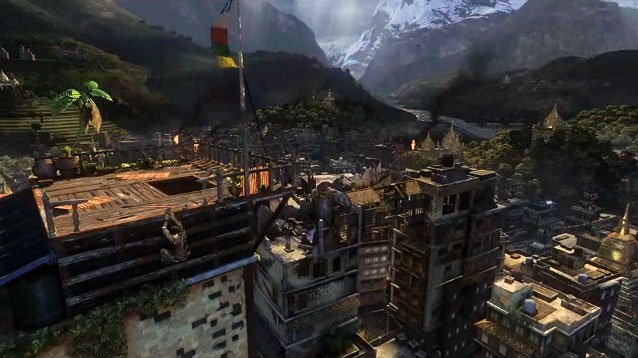
Uncharted 2 is very, very pretty. I find the relentless shooting a bit monotonous, but they have done an excellent job of mixing storytelling and gameplay.


I'm replaying Super Mario Galaxy with my four-year-old. It's reasonably fun.


PixelJunk Shooter is a solid little game that I'd recommend to almost anyone. Its looks belie its technical sophistication. It's one of two games I played recently to compare and contrast with my lunar lander project. Shooter sets a high bar and is making me rethink some things. For instance, they use a grappling hook to rescue astronauts, instead of landing next to them as is traditional in this type of game. The result is that the game flow moves much more quickly.


My wife's been playing Picross 3D obsessively since it came out. I finally got some time with it last night; it is really, really fun. Picross 3D uses a rather heavy-handed tutorial system to teach you the game; after playing Everett Kaser's logic games, which always stay out of your way but provide excellent hinting, it's a bit hard to take. Otherwise it's great.


Gravity Crash is the other game I played for inspiration in my lunar lander game. Unfortunately I just didn't find this one very fun at all. It feels like a total ripoff of Gravitron 2, and one of the problems they share is a tendency to add energy to the ship when colliding with the terrain. The result is that one collision can quickly spiral into being completely out of control, bouncing this way and that until the ship explodes. It suffers especially when compared directly with PixelJunk Shooter.


Flower is a nice, short little game. My four-year-old can play it fairly well. I do wish there was an option to steer with an analog stick instead of with accelerometers. About half the time you feel like the wind soaring over a field of flowers (as intended), and it is exhilarating and beautiful. The other half of the time you feel like you're trying to turn a semi truck around in an alley.

Monday, March 29, 2010

Transcendence 1.0


Transcendence reached version 1.0 this past week, so I have been playing some of that. George Moromisato has been developing it in his spare time for the past fifteen years. Transcendence takes the basic flying and shooting action gameplay of the Escape Velocity series and enfolds it in a game that is otherwise heavily indebted to Nethack.

After picking a trader/fighter/balanced ship, you are off on a quest to reach the galactic core or some such. You get there by warping through a series of semi-random solar systems.

Each system has jump gates connecting it to the next and previous systems; exactly like the up/down stairs in Nethack. Instead of rooms forming a dungeon you've got planets which orbit around the central star(s). At the planets you'll find friendly bases with shops and quests, or hostile bases which will deploy a bevy of fighters against you. Looting wreckage supplies you with things to use or sell. There are space analogues for magic potions and scrolls of enchantment. You have a deity to whom you can make sacrifices and from whom you can request aid. You've got tinker bases that will transmute junk into items according to their own recipes. There is a gladiatorial arena for earning money by fighting other spaceships. You can even acquire robotic sidekick ships. And behind it all is the ticking clock of your fuel consumption: run out and it's game over.

Unlike Nethack the universe is not wholly hostile. Trading ships ply the major routes within each solar system, and the friendly bases may have fighters that will launch to defend their allies.

The game's interface has some holes that I wish would be patched up. It's cumbersome to examine your ship's current configuration for comparison while shopping, for instance. When you are submitting items to the tinkers for transmutation it would be nice if the list would only show things they accept; nicer still to see recipes for things so you know what to be on the lookout for when you're collecting loot. Quest management could be improved as well; there isn't currently any way (that I've found) to remind yourself of the details about what you're supposed to be doing.

I wish there were more ability to communicate with other ships in the area. Being able to respond to distress calls or request help would do a lot to make you feel more connected to the world. Also there seem to be quite a few space bases that don't really do anything which just makes the universe seem more boring. I haven't figured out what the pubs and nightclubs are for yet, and since I've never been able to figure it out I've stopped looking into them. If they ever do become useful I won't know, and that's just bad design.

On balance, though, the game does do a fairly good job of encouraging you to play just a little bit more to see what new things you will discover. It's free so give it a try if you are at all a fan of space games or roguelikes.

Monday, January 4, 2010

Mini-reviews

I actually managed to play some games over the holidays, something I haven't done much of in a long time. My opinions:

Torchlight: Pretty but extremely repetitive Diablo clone. Still good for a few hours of fun.

Might and Magic: Clash of Heroes: Fantastic gameplay burdened with a generic fantasy license (saying this as a one-time Might and Magic fan). Inventing a puzzle-based battle system has been a goal of mine for a long time and I'm very impressed with the one Capybara has concocted here. I saw Critter Crunch on PSN last month and there are definite similarities. I loved the fiction surrounding Critter Crunch. Here it's the usual overwrought elves-n-paladins stuff, but you should try your best to overlook that because the gameplay's great.

Zelda: Spirit Tracks: Partway into this one. Moderately interesting. The train seems like it has potential to be a real drag.

Halo: ODST: Meh. Fight a bunch of dudes through a series of tunnels that are supposed to be a city. Some day there will be a game set in a city where you can actually go into any building and the layouts are not intentionally mazelike to compensate for hardware handicaps. This is not that day. This is essentially the Halo 3 Remix, at least in the single-player.

Assassin's Creed: (the first one) Surprisingly less polished than I would have expected given the size of the development teams in Montreal. I'm only partway into this one; I like the environments. The animation is atrocious though, with pops and hitches continually violating characters' appearance of weight.

Mass Effect: Also only partway into this one. I love their character rendering system during cutscenes. Very cinematic lighting. Of course the lip-sync brings everything crashing down. Animation is the Achilles' heel of all current CG, even $350 million epics like Avatar.

Saira: Tried the demo, decided it was a bit too frustrating for me. I loved Nifflas' previous games though. If you haven't, check them out.

Monday, November 30, 2009

Child of Fire, Red Cliff reviews

The weekend, while long, was busy. We hosted two events: Thanksgiving and my daughter's fourth birthday party. I wasted what little free time was left reading Child of Fire: A Twenty Palaces Novel and watching John Woo's historical epic Red Cliff.

Child of Fire came to my attention via John Scalzi's Big Idea series, where authors get to plug their new books. First-time author Harry Connolly wrote an entry about his book that intrigued me despite the book's atrocious name. I finally got around to picking up a copy of the book and reading it. It's very well written and I'm looking forward to his future work. Recommended if you like Dashiell Hammett or Chandler.

Red Cliff is based on a 3rd-century battle retold in the 14th century Chinese novel Romance of the Three Kingdoms. When I worked at Midway we watched a bunch of Woo's films in preparation for working on a videogame with him. A lot of his trademark Wooisms can be found in this massive historical epic (cut down to 2.5 hours for US release). For instance, in Hard Boiled Chow Yun Fat's character blasts his way out of a hospital with a shotgun in one hand and a baby in the other. The opening of Red Cliff features a very similar incident, which I'm guessing was not in the original novel. Other Woo-bits include doves (of course) and Mexican standoffs, albeit with swords rather than guns. And random slo-mo of the duplicated-frame sort.

The characters felt really stale to me. I am interested in reading the original novel now to see if they are this one-dimensional there. The two characters that I felt stood out were Kong Rong (played by Wang Qingxiang), who was the tactical genius on the rebel side; and Xiao Qiao (played by Lin Chi-ling) who holds a Helen-of-Troy position in the story but with a strong Judith moment near the end.

I'd played one or two of the Dynasty Warriors games previously so a lot of the supporting hero characters (like Guan Yu) felt familiar. It is a little odd to have my scant historical knowledge derived from there, but that's how it is!

Monday, December 8, 2008

Spirit Engine 2 (demo)

I have been too busy keeping the household running this week to get any programming done.


I did manage to play the demo for The Spirit Engine 2, a largely-solo development effort. Mark Pay did the coding, design, and art, with Josh Whelchel composing three hours of music for the game. The game is a side-scrolling role-playing game set in a fairly novel universe (to my eyes, anyway) reminiscent of some of Miyazaki's movies. The production values are excellent. The writing could stand tightening in places but is nonetheless quite readable. Having not played the entire game I can't judge the overarching storylines although there appears to be some fairly heavy foreshadowing. If the mysterious overlords who manage the affairs of men don't turn out to be evil I will be stupefied with astonishment.

My main gripe is that the battle system is not explained in enough detail. It involves building chains of actions for each party member (prior to battle) and then selecting chains of actions dynamically. I don't have a good handle on how to do this, though; the tutorial didn't go into it very well. The interface for building action chains could stand to be improved as well; you can't examine the details of actions while you are assembling chains.

Another problem is that the keyboard interface seems to be an afterthought. I played mostly with the keyboard and it took me a while to figure out that I could open treasure chests, for instance, since they have to be clicked with the mouse. This wasn't explained.

Basically, the game could stand to have more focus-testing on new users to ensure that the ramp-up is smooth. Otherwise, it appears that once you are familiar with the game mechanics it will be a delightful experience.

Monday, November 3, 2008

Multiple predefined levels

I'm averaging about one hour a week of work on my little game project. This week, I added support for multiple predefined maps. I'm thinking it is time to create a new test map that can help me answer questions about size: whether the game will primarily center around guarded compounds or if there are interesting things that would include surrounding city as well.

The prospect of creating a larger map using a text editor is daunting so I'm considering whether it might make sense to have a simple in-game editor. That is a pretty big change to how things work, though.

Other things I've done this week:

I bought Gothic from Good Old Games and have played it a little bit. I had played its sequel Gothic 2 several times, including with its Night of the Raven expansion and I have always wanted to try the first game in the series. It's been an interesting experience because Gothic 2 included Gothic's map as a subset of its world (albeit with some major changes due to war) so I am finding that I already roughly know my way around.

The Good Old Games folks are doing a great thing by fixing up old games so they'll run on modern computers and selling them without DRM. I had a terrible time trying to get my original Gothic 2 discs to run on my recent computer due to the execrable (StarForce or SecuROM, I forget which) DRM they employed. After getting the runaround from Gothic's publisher and some ineffectual assistance from the DRM company I ended up just buying the rerelease of the game, which (as is common) omitted the DRM. I suppose I'm sending the wrong message to the publisher by re-buying the game. (I tried looking for no-CD cracks first, believe me.) If I could personally deliver a good stiff whack with a stick I would.

I picked up John Christopher's Tripod series of young-adult sci-fi books at the library and have started reading those. They got made into a BBC show which I haven't seen. The setting is Europe a few hundred years after Earth has been enslaved by alien overlords, who use mild neurological pacification to maintain the remaining humans in a feudal state. Humans are fitted with “caps” at puberty; most become contributing members of society. In a small percentage of people the procedure fails, producing mentally ill vagrants. It sounds darker in my telling than it seems to me as I read it.

I played a bit more World of Goo but am stuck on a level in the Fall world now. This game is charming but it's not really my type, I think. Each level seems to consist mainly of finding the one trick that is necessary to complete the level, so it is more of a “get into the designer's head” than an avenue for creativity. My two-year-old likes watching me play, which makes my wife uneasy (there is a macabre undercurrent in the game which mostly goes over toddlers' heads).

Finally, I have been reading up on motion planning. I found a good survey paper here and an excellent textbook here.

Monday, September 29, 2008

Review: Gravitron 2


Gravitron 2 is a retro-style arcade shooter in the vein of Gravitar and Thrust. You fly a rocket to a series of tiny planet surfaces, where you must destroy one or more reactors and then make your escape before the entire planet blows up. In addition to flying and shooting, the ship is capable of landing on any flat surface, which is useful for rescuing engineers. Each rescued engineer repairs a bit of hull damage as well as adding a bonus to your score for the level.

The ship controls are a slight update to the Lunar Lander family. The mouse's X axis directly orients the ship, and there is a button each for thrusting, firing, and shields. Thrusting and shields expend fuel, which can be replenished by landing or hovering near fuel depots in the levels.

The game has a nice variety of enemies. Levels often contain moving parts. There are occasionally gates with switches, and destructible trees. Each level has a checkpoint; when you first touch the checkpoint, it snapshots the enemies alive at that time. When you die the game restarts you at the checkpoint with the snapshotted enemies. Thus there is an incentive to try and clear as big a swath of the level as possible before touching the checkpoint, which is risky.

I have not finished the game; I think I'm about twenty levels in. I don't think the difficulty curve is as smooth as it ought to be (I'm reviewing version 1.5). Gravitron 2 is brutally hard in places; I've played some levels dozens of times to get through. I have a dormant game project that uses almost this exact interface, so I was already quite good at flying the rocket, and it is still really hard for me. In general the game does a good job of encouraging “Just one more try” gameplay, though. My two-year-old daughter likes watching the game; when I die she tells me “We have to try again!”

I was just over at the Chipmunk physics library page and noticed the game author's handle in the forums, so I wouldn't be surprised if Gravitron 2 makes use of the Chipmunk library for its physics. In general the game's physics is impressive, but there does seem to be some inconsistency in how much damage collisions with the environment do. I also wish the rocket didn't bounce quite so much off of walls.

There's a free demo available with the first five levels. If you like it, the full game only costs $5 (at this writing) so it's not a difficult purchase to justify. In terms of hours of gameplay per dollar this is a great value.

Ron “X-Out” Bunce has since updated his game to version 1.7, fixing several minor interface quirks and an instant-death physics bug. Give it a try!

Monday, September 8, 2008

Coming back gradually

I got a new hard drive and have been gradually getting everything reinstalled. I'm taking the opportunity to upgrade in a few places along the way.

The 2008 edition of Visual Studio Express fixes the bugs that annoyed me in the 2005 edition: the inability to double-click on solution files in Vista, the extra security dialog check, and the inability to drag and drop files onto the Visual Studio editor. All of these are the kinds of things you'd think would be impossible to break in a long-running product like this, but they probably re-implement everything periodically just to keep life interesting.

Beyond Compare has a new version 3.0 out; they finally implemented 3-way merge although they charge an extra $20 for it. This diff utility is an integral part of my day job and I can't imagine working without it. There are much more expensive solutions out there (Araxis Merge) but I think Beyond Compare delivers some of the best value.

I'm getting more and more pissed off at Perforce, mostly because I'm the de facto Perforce administrator at work. I am unimpressed (version 2 of my post) with the current programming lineup behind this product. The current GUI client (P4V) is quite noticeably slower than their old Win32 client (P4Win) despite years of development and suffers from incredibly bad user interface design and a never-ending stream of bugs. As an example of the bad user interface, the Sync and Checkout buttons are adjacent on the toolbar. Once or twice every month somebody will select the root of the art tree and accidentally check out everything. This action is very quick and locks everyone else out from checking any of the art files out. Unfortunately reverting the checkout takes hours, unless you use command-line trickery. The old P4Win client, by asking the user “Do you really want to check out 60,000 files?” avoids this sort of problem. I've requested that they put this warning into P4V since it is present in P4Win, and I've reiterated that it's a problem four or five times, and in as many releases of P4V they have not done it. I haven't even mentioned the inexplicable problems with the user interface, like not being able to get the Submit dialog to appear, and I haven't mentioned the Qt debacle, whereby they used a DLL with the same name as a DLL in Maya, and from the same vendor, but with different function sets, thereby rendering either P4V or Maya inoperable depending on which came first in the PATH.

The Perforce server, which was written by the Wise Ones at the Dawn of Time, continues to be a most excellent piece of software. It's a shame that all we can do is gaze back in wonder and mystification at these relics of a bygone era.

I'm considering switching to a different version control for personal use. My criteria are: free, easy to install and administer, fast, and no “turd files” littering my work directories. A good GUI client would be nice too. Wish me luck; I have a feeling such a combination of things does not exist.

I've tried out Google Chrome for a while. It is a decent browser but has a tendency to get very thoughtful (shall we say) when you require it to share those 4GB of RAM with other programs.

Finally, Jungle Disk was the real star of this computer breakdown. I was able to restore my backed-up projects with no trouble. They've continued to improve the interface of the client.


It's past time to return to work on my little game; I've been getting antsy while my computer's been out of commission. Fortunately there have been things like crunch time at work to fill the void. I'm looking forward to getting back to work this week, though.

Monday, June 16, 2008

Review: Treasures of a Slaver's Kingdom

Treasures of a Slaver's Kingdom is a text adventure of sorts by S. John Ross. It's likely to offend the sensibilities of Real Interactive Fiction lovers, as it pares down input to a handful of commands. I love this because I hate “guess the verb” gameplay. Treasures also features simple stats-'n'-dice-based combat, which puts some people off. On the positive side, it's a giddy pulp pastiche of Conan, Star Wars, and more. Atomic dinosaur? Sure! Give him a light saber! The writing is frequently hilarious. The game is solidly designed: the environment is fairly small, the inventory is kept to a manageable size at all times, and you can't really get stuck.

I discovered the game through Emily Short's excellent (as always) review over at Play This Thing. I really can't add much to her review, so head over there to read it.

Treasures does a good job of making memorable non-player characters. You actually feel like you've got a relationship with them. I think the limited input vocabulary helps here as it keeps you from getting frustrated trying to interact with them.

The full game costs $13, which I think might be slightly much for the amount of gameplay. I got through the game in under eight hours, although I made fairly extensive use of the crypto-clues offered in the instruction manual, to the point of writing a Python script to decode them for me. However, I spent the entire time playing the game with a big grin plastered on my face and laughed out loud on several occasions.

There's a free demo that lets you play the first fifth or so of the game. Try it out and see if it agrees with you. You will also need a Z-machine interpreter to run the game; Gargoyle is a very nice-looking one.

Monday, March 31, 2008

Phoenix Wright: Trials and Tribulations

Unpacking took up most of my spare time again. I was given a copy of the third Phoenix Wright game which I've been playing in snatches.

The Phoenix Wright games barely qualify as games. They're more like interactive novels, with that peculiarly Japanese fixation with dribbling text out a letter at a time. However, they are extremely well-written. You play a hapless defense attorney with a teenage spirit-medium sidekick who channels her dead older sister at crucial moments, and natters on about hamburgers and other wild tangents the rest of the time. All the characters are goofy and likable and the murder mysteries have outlandish twists. The legal system presented in the games is completely insane: defendants are guilty until proven innocent, and you have a strict three-day time limit in which to do so. Both prosecution and defense regularly pocket evidence from the crime scene in order to be able to produce it with maximum dramatic effect in court. The judge is credulous in the extreme; his opinions typically seesaw wildly over the course of the trials.

The first outing on the DS had an extra chapter written specifically for the DS, with various minigames that made use of its peripherals. For instance, you could dust for fingerprints, by tapping with the stylus to put down powder and then blowing into the microphone to clear it away. None of the subsequent Phoenix Wright games have done anything like this. I think I read somewhere that the series originated on PC in Japan and is being ported to the DS by installments. (The special DS-specific episode was also noticeably less well-written than any of the rest of the series.)

The third game is pretty consistent with my memories of the first two (barring the special episode). I'd recommend it to anyone who played and enjoyed the first two. If you're a newcomer you should be able to pick it up without problems; they do a good job of ramping you up on the mechanics of pocketing and presenting evidence. The tangled web of character relationships may take a bit longer for you to figure out, that's all.

Monday, November 26, 2007

Super Mario Galaxy and Camera Control

Thanksgiving was a busy weekend, with lots of friends and family at our house. I played a bunch of Super Mario Galaxy, too. I like the bite-size gameplay pieces, and the live orchestral soundtrack.

On the downside, the camera is even crazier than in other third-person action games, which reduces the game's appeal for non-hardcore gamers. There are a couple of reasons for this. One is that there is almost no manual control over the camera. Sometimes you can press the D-pad to reorient the camera, but due to the controller geometry this is not something you can do easily. The other reason the camera is squirrelly is because the worlds have unusual geometries. As a result there is a lot of camera hinting (at my day job we call them camera volumes). This is where designers mark a region of space and give a preferred direction for the camera for that region. Due to the crazy gravity it's necessary to swing the camera direction wildly from region to region.

As anyone who's worked on 3D action games knows, there is a fundamental conflict between character control and camera control. You've got two basic choices for character control: character-relative and screen-relative. Character-relative is characterized by the Tomb Raider series (at least the early games; I'm not familiar with the more recent efforts). I call this “radio-control car” control because it has the familiar problem that if the character is moving toward the camera, you have to push right on the stick to get them to go left on-screen, and vice versa. As a result of this, virtually all third-person games (including Super Mario) use screen-relative control. The joystick deflection is projected to the screen and the character moves directly in that direction. Right is always right and left is always left.

Screen-relative control is great, until you need to rotate the camera. Suddenly the frame of reference that the player is using to control their character has shifted. If they're trying to run along a narrow beam, say, and you rotate the camera, suddenly their character will veer off and plunge to her death. If the player manually rotated the camera then they're expecting it and can adjust their movement to compensate, but if the game is controlling the camera the problem is much worse.

There are various tricks that we've tried to get around this. For instance, if the movement joystick is deflected and then the camera rotates, you can continue the character on their previous course until the player lets up on the joystick, after which any subsequent deflection will be projected to the current camera frame. This has mixed results, and probably works best when you're outright cutting the camera from one view to another.

Super Mario Galaxy has an additional problem with screen-relative control that most other games don't. I mentioned above that you project the joystick deflection onto the screen. There are various ways to do this, but usually they involve projecting the controller deflection onto a ground plane, so that pushing up on the stick moves the character further away on the ground (upstage), and pushing down moves the character nearer (downstage). In Mario, the player is sometimes running around on the ceiling, which introduces a new problem: should pushing up on the stick move Mario further away, or toward the top of the screen (which means running closer to the camera)?

In order to make screen-relative character movement work as well as possible, you basically want to make smooth, slow adjustments to the camera so the player has ample time to correct for the change in their character movement. On top of that you can add a manual control to snap the camera quickly to a better direction. That way, the player can stand still when they adjust the camera.

Unfortunately Super Mario Galaxy's environments don't lend themselves well to smooth camera adjustments. Gravity changes directions suddenly, or worlds will be tight and twisty, necessitating rapid camera movements to keep Mario in view. I'm having fun with the game, but it makes my wife really dizzy just to watch it.

Monday, September 3, 2007

Knytt


I found out about Nifflas' games this week. They are fun, polished, atmospheric platformers, well worth checking out. I started with Knytt, which focuses on exploration and atmosphere and is lighter on combat. Knytt Stories is a collection of games that add more combat to the mix (although many of them have an easy difficulty which removes some of the enemies). Within a Deep Forest is the oldest game, with a more difficult control scheme which involves moving a bouncing ball.

In all of the games Nifflas has assembled great atmospheric music from a variety of composers, and clean, charming tile design.

Monday, August 6, 2007

Reviews: Might and Magic series

I was away all weekend in Brewster so I didn't get anything done this week.


Might and Magic was a long-running series of computer role-playing games. I played primarily installments four through six. This is not to be confused with the Heroes of Might and Magic series, which is also a great series of games. The capsule description of these games is: goofy but incredibly fun.


The quality trailed off rapidly after number six; interestingly, that was approximately the same point at which New World attempted to change their art style. Up until then they had used every crayon in the box, with favor toward none. This was replaced in later games by a pretty generic “realistic” look (read “look Ma, I'm using 3D Studio!”).

Might and Magics 4-6 had many good points, though. The interface holds up surprisingly well, especially when compared to other RPG franchises from that time period. The games did a great job of giving you a feeling of progress. Your characters gain ridiculous numbers of levels (at least compared to anything Dungeons-n-Dragons based). #6 had vast armies of monsters which would give you enormous difficulty early in the game but could all be felled with a single spell later on.

Quests were nicely handled. You would get a quest from a person. After completing it you would go back and get thanks and a reward. Often you would also get a title of some sort (something like “Savior of Smallville”) which went into a special screen for collecting honors. Any time you talked to the quest-giver again they would offer their profuse thanks. It really gave a good sense of accomplishment.

Travel tedium was reduced carefully as you proceeded. The games all came with a poster-sized map of the world. At first you'd have to walk from place to place. (Although, in 4 and 5 if you knew the names of the towns you could travel there instantly using the travel mirrors.) Later on you'd acquire spells that gave you better and better travel options.

Might and Magic 6 marked the series' transition from grid-based design to full 3D. They did a pretty good job with the transition. The world is divided into zones; each zone can be cleared of enemies, upon which it will reset in a few months of game time. The reset keeps travel from becoming boring and demonstrates your characters' growing prowess as the monsters become easier and easier to vanquish.

Dungeon design was highly varied, especially in the grid-based games. I remember one dungeon that was laid out as a crossword puzzle, for instance.

Another nice touch in Might and Magic 4 was that you could eventually acquire your own castle.

It's been a while since I've played these games but they are in my small set of games that I've played multiple times. I've also bought them several times over since I lend out the CDs and don't get them back. Highly recommended!

Monday, July 16, 2007

Heinlein's Juvenile Novels

I've been reading through Robert Heinlein's juveniles the last three weeks. I had read Rocket Ship Galileo and Podkayne of Mars previously, and was able to get most of the rest through the King County Library system. So far I've read:

Rocket Ship Galileo
Red Planet
Farmer in the Sky
The Rolling Stones
Tunnel in the Sky
Citizen of the Galaxy
Have Space Suit, Will Travel
Podkayne of Mars

It's not a juvenile, but I also read The Moon Is a Harsh Mistress recently. I've got Starman Jones and Time for the Stars left in my pile.

Heinlein's great enthusiasm shows through in all his books. His future is optimistic with regards to the relationship between humans and their technology. I don't think I've ever read a dystopia from him. He tries to educate people about how the world works, and to think carefully about how it might work in the future. Heinlein doesn't limit himself to thinking about how technology might evolve; he is also keenly interested in how societies and their customs might evolve as well.

These juveniles were all written prior to the moon landings. Nevertheless, Heinlein knows enough about space, orbital mechanics, pressure suits, and rocket engines to make things pretty plausible; certainly far more plausible than a lot of modern “realistic” space fiction. I remember reading a novel a year or two ago featuring your typical Star Trek-inspired space battleships with people sitting around and verbally relaying orders. The author seemed to think that his ships could “take the high ground” in a solar system by orbiting around its sun faster and faster; they were then able to strike more readily whenever and wherever a threat appeared. Completely ridiculous!

Computer games have the potential to give players visceral understanding of complicated concepts. It would be neat to have a fun game that gives people an intuitive grasp of orbital mechanics and the dimensions of our Solar System. This would, if nothing else, give authors of generic sci-fi better mental pictures of how things work, so they can avoid the dumber mistakes. When the kids of the 40s and 50s grew up to make real rockets, they had in mind the pictures planted there by Heinlein and other authors.

Monday, June 18, 2007

Everett Kaser's games

Everett Kaser is the master of deductive logic games. From his lair near Corvallis, Oregon he unleashes a steady stream of clever, addictive puzzlers.

If you've ever tried out one of those pen-and-paper puzzles that has three people, three houses, three jobs, and some clues like “The person who lives in the red house is not a carpenter” you know roughly what the games entail. Kaser has designed his games so that the clues are presented in graphical form, and has blended in visual puzzle elements.

For instance, in Honeycomb Hotel you are trying to determine which of several options belongs in each hexagon in the board; but you are also simultaneously trying to determine a Hamiltonian path that enters the board, visits each hex, and exits. Here's an example of a very simple puzzle with two clues:


Each hex contains its possible options; you can eliminate them as you work through the clues. The central hex's contents have been given. The left clue says that the mouse and the letter H are adjacent and connected by a path. The right clue says that the grasshopper and the letter Y are adjacent but separated by a wall.

There cannot be a path connecting the entrance and exit hexes, because then the path wouldn't visit any of the other hexes on the board. This rules out the possibility of mouse and H being on the right side of the board. Once they are placed, Y is known, which places grasshopper and the rest. Here's a partial solution; can you see how to finish it?


Baker Street, another personal favorite, replaces the Hamiltonian path with a tree and is on a board of mixed squares and hexagons, for more varied connectivity:


My wife and I have spent more time on these games than any other. Free demos are available for everything. Give them a try and see if they are to your taste.